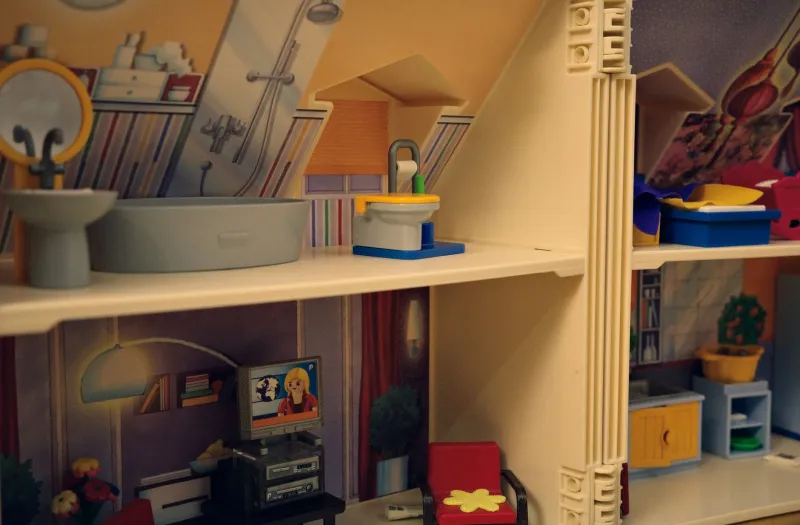
Kerbside Theatre: Giving a 1:12 Front Garden Its British Manners
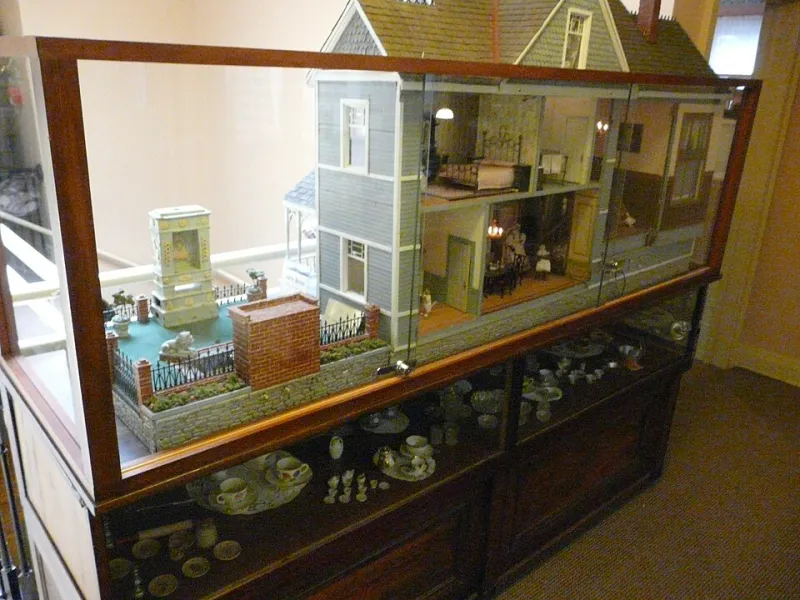
Photo: myself (User:Piotrus), CC BY-SA 3.0, via Wikimedia Commons
Most miniature houses are photographed from the doorstep inwards. The rooms get the rug, the lampshade, the tiny newspaper folded on the arm of the chair. The front garden gets a bit of green flock and a apologetic little gate. Which is a shame, because in Britain the front garden is where a house performs its manners. It is the clipped hedge that says someone is paying attention, the cracked path that says the house has been here a while, and the wheelie bin that says real people live here and they put the rubbish out on a Tuesday.
Start at the boundary, not the door
A 1:12 front garden works best when you think of it as a strip of kerbside theatre. You are not really modelling plants. You are modelling the relationship between private space and public pavement. That means the boundary matters more than the planting.
Begin with a low wall or a hedge line and give it a job. A wall in stretcher bond, built from embossed styrene or thick card, should sit on a foundation strip so it does not look like a biscuit balanced on a plate. A hedge should have a flat top and slightly uneven sides. Real privet and box are clipped by hand, not laser-cut. Build an armature from florist wire or fine aluminium mesh, bulk it out with foam, then coat it with diluted PVA and sieved foam flock. When it is dry, trim the top with sharp scissors. Then trim it again, because the first trim always looks too timid.
A path that has been walked on
A perfect path is a dead giveaway. British paving cracks, settles, grows moss in the joints and collects grit in the corners. Make your slabs from DAS clay or foam board, press a few shallow lines into the surface, and lay them with tiny variations in height. A slab that tips up by half a millimetre at 1:12 is a slab that has a tree root underneath it.
Weather the path with dilute acrylic washes — grey-brown, a little green, a little black in the joints. Do not paint moss as a green stripe. Dab it. Use fine flock, a tiny amount of ochre paint and a dry brush. If you want winter damp, add a thin sheen of satin varnish in the low spots and leave the rest matt.
The path should also lead somewhere. A front garden with a path that stops at a blank wall looks like a film set. Add a step, a boot scraper, a drainpipe shoe, a house number. Small infrastructure sells the scale.
The gate that hangs slightly wrong
A gate that closes perfectly is a gate that has never met a British winter. Hang yours with a deliberate lean. Brass tube hinges, a twisted wire latch and a post that is not quite plumb will do more for realism than any amount of fancy wood grain.
At 1:12, a front gate is roughly 75mm high, so the wonk has to be subtle. Tilt the whole gate by a degree or two, leave one hinge pin slightly proud, and make the latch miss its keeper by a whisker. If you want a story, add a loop of wire where a child has hooked the gate back, or a scrap of twine tied around the post. The gate should look as though someone meant to fix it in the spring and then the spring got busy.
Bin day and its supporting cast
A wheelie bin is a beautiful thing in miniature because it is ordinary, ugly and specific. A standard UK wheelie bin is about 1,070mm tall, so at 1:12 you are looking at roughly 89mm. You do not need to model every rib. A styrene tube or a small pill bottle with a flattened lid, two bead wheels and a wire handle will read instantly.
Colour is a trap. Bin colours vary by council, so unless you are recreating a specific street, choose a neutral dark green or grey and let the shape do the talking. Add a recycling box in a faded blue, a food waste caddy with a clipped lid, and perhaps a flattened cardboard box tied with thread. Bin day clutter is the fastest way to make a model house feel inhabited.
Give the bin a backstory, but keep it small. A scuff on one side. A number stencilled on the lid. A split bag that never quite made it into the bin. The story should be visible from the pavement, not explained on a label.
Leaves, moss and winter manners
British front gardens are not pristine between November and March. They are wet, leafy and slightly neglected in a way that feels affectionate. Leaf litter is your friend. Punch tiny leaves from brown paper, crumble dried herbs, or use real tea leaves dried and sieved. Fix them with hairspray or matt varnish in the corners where the wind would naturally drop them: against the wall, behind the gate, in the gutter line.
Add a little moss on the north-facing side of the wall. Let the path darken near the door. Put a spiderweb in the corner of the gate, but only one. Too many cobwebs and the house stops being lived in and starts being haunted.
The finishing pass
Stand back and look at the front garden from pavement height. Can you see the door? Can you see the bin? Does the gate look as though it has been opened this week? If the answer is yes, you have built a front garden with manners. Not perfect manners. British manners: slightly apologetic, quietly observant, and absolutely certain that the bins go out on the right day.