Mud on the Lino, Milk on the Step: A 1:12 Boot Room That Works for Its Living

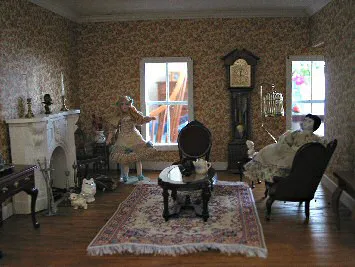
Photo: miniature dollhouse boot room with wellington boots coat hooks and doormat, via image.tmdb.org
There's a particular kind of British back porch that no interiors magazine would touch. Lino curling at one corner. A peg rail with one hook pulled out of the plaster. Six wellies, none of them in pairs. A bottle of milk on the step that's been there since half seven. It is, by any measure, the least designed room in the house — and at 1:12 it is also the most useful one you will ever build.
Because a dollhouse lives or dies on whether you believe people walk through it. And nothing makes a viewer believe it faster than a small, cold, slightly grubby space where the weather stops.
The Room That Lies Least
Most miniature rooms are built to be admired. A 1:12 sitting room can be immaculate and still work, because sitting rooms are, in real life, occasionally immaculate. But a boot room has no alibi. It is a working room. It exists to absorb wet coats and muddy boots and other people's post, and if yours looks styled rather than used, the whole house starts to feel like a set.
Get the porches right — see also our piece on the front garden and its kerbside manners — and the rest of the build gets a sort of permission to be ordinary. Get it wrong and the parlour can be a masterpiece and nobody will quite believe it.
The good news: this is the cheapest room in the house to furnish. Almost everything in it is offcut, salvage or charity-shop stock.
Plan the Wet Before You Plan the Walls
Start on the floor, not the walls. In a real boot room, the layout is dictated by where water goes, and yours should be too.
- Floor. Quarry tile effect is the easiest win. Cut 25mm squares from thin card or 1mm greyboard, paint them in two or three slightly mismatched terracottas (they should not all be the same colour), lay them with 1mm grout gaps and finish with a matt varnish. A single chipped corner on one tile, with the chip glued back slightly out of register, does a lot of work.
- The step. A threshold of 10–12mm in balsa or obeche strip, painted a worn dark green or stained, gives the room a sense of being lower than the hall. Put a boot-scuff of grey paint along the top edge.
- The door. Half-glazed, painted in an off-white that's gone slightly yellow, and left about 30 degrees open. You get light, you get a view into the room, and you avoid the classic 1:12 mistake of a door that swings into a floor that's already full.
- Outside. If your build has any exterior at all, give yourself 40mm of wet-looking path and a small square of grass. The inside of a boot room only makes sense if you can see a bit of the weather it's protecting you from.
One more planning note: hang the ceiling light slightly off-centre and lower than you think. Boot rooms are usually conversions, and conversions never quite get the pendant in the middle.
Wellies That Look Actually Wet
This is the piece that does most of the storytelling, and it's a twenty-minute job once you've got the materials.
Heat-shrink tubing is the cheat. Take 3mm tubing for a child's boot, 4–5mm for an adult's, slide it over a cocktail stick and warm it gently with a heat gun or a lighter held well back. Cut to 25mm for an adult wellie (roughly a 30cm boot at 1:12). For the foot, either bend the tubing before it fully cools, or glue on a small bead filed flat on one side.
Finish with a thin rim of tubing for the cuff, score two or three shallow lines across the sole with a craft knife, and paint. Choose dull olive, navy, a faded pillar-box red, the kind of dark green that country types wear. Then — and this is the bit people skip — give the lower third a coat of satin varnish and leave the top matt. Add one small blob of gloss on the toe. Set a pair down, knock one over, and let a second, non-matching boot lie on its side by the door.
Water, in other words, is a lighting effect. You're not recreating wetness, you're recreating the shine of it.
Hooks, Leads and the Hat Nobody Wears
A peg rail is just a strip of 1mm x 6mm stripwood, 83mm for every metre in real life, with beading wire pins or tiny beads for hooks. Don't space them evenly. Real rails get hooks added over decades, by whoever had a drill that day.
Load it badly on purpose:
- A dog lead made from a strip of thin leather, cut from a charity-shop glove, coiled and hung from a split ring.
- A waxed jacket — fabric stiffened with diluted PVA, sheen of satin varnish on the shoulders, one sleeve hanging lower than the other.
- A single glove on the floor, three feet from the rail, which is where single gloves live.
- Keys in a shallow dish: two or three jewellery findings and a tiny fob, plus one key slightly too big for the lock.
Leave a bare hook. Leave two.
The Draught Excluder That Never Quite Fits
There is a specific pleasure in a draught excluder that has given up. Make a fabric tube roughly 90mm long and 10mm across, sew or glue one end, fill with rice or seed beads, and gather the other end with a doubled thread. Then place it against the door with one end riding up onto the threshold and a visible gap at the hinge side.
Perfectly fitted, it reads as a model. Slightly wrong, it reads as a Thursday in February.
If you want to go further, make a second one in the shape of a dachshund, and have it shoved under the radiator instead.
Clutter That Only Looks Accidental
Work in three layers. Fixed is the rail, the floor, the radiator. Semi-fixed is the boot tray, the shoe rack (three shelves of 1mm balsa, deliberately uneven) and the shelf above the radiator. Loose is everything that could plausibly have been put down five minutes ago.
That third layer is where the room comes alive:
- A milk bottle on the step with a foil top, and a second one already empty by the sink.
- A parish newsletter, printed at 8% and folded so the corner turns up, half under the boot tray.
- A boot jack — two balsa offcuts and a pin.
- A tin of polish with the lid ajar and a brush beside it, bristles faintly tacky with wax.
- One crumb of brown Fimo on the lino. Just one.
Replace two of these every few months. A room that never changes starts to feel embalmed.
Light, Heat and the General Damp
A warm white micro LED tucked behind the half-glazed door, plus a low-voltage bulb under the shelf, is enough. Aim for about four o'clock in November — bright enough to see the wellies, dim enough that you want to go inside.
The radiator (a piece of 6mm stripwood with vertical grooves scored in, painted off-white and given a faint tide-mark of rust at the base) does the rest, especially with a towel folded over it and a pair of socks on the rail above. A coat hook with a canvas bag that's slightly too full. A spider's web in the corner, made from a single strand of stretched hot glue.
What to Spend and What to Skive
Spend on: heat-shrink tubing in three diameters, fine brass wire, 1mm square stripwood. That's it, really.
Skive on: coir doormat (cut a 60 x 40mm piece from a full-size one), leather for the lead, fabric for the excluder, beads for hooks, and the newsletter, which costs nothing to print at 8%.
The last thing to add is a smell. You can't, obviously. But if the viewer's eye lands on wet lino, a warm radiator and a bottle of milk, their nose fills in the rest. That's the trick of this room. It doesn't ask to be admired. It asks to be walked through — and once a viewer believes they could walk through it, the rest of the house is theirs.