Switched Sockets and Stewed Tea: Twelve Small Tells That Make a 1:12 Room Read British
Photo: Suir Riverstown, CC BY-SA 4.0, via Wikimedia Commons
There is a moment, usually late in the evening with a mug going cold beside you, when you photograph a finished room and something reads wrong. You cannot name it. The wallpaper is right, the little armchair is lovely, the rug took three weekends. And yet the picture looks American.
Nine times out of ten it is not the furniture at all. It is the bones of the building — the hardware, the services, the surfaces that nobody chooses and everybody lives with. British homes have a vocabulary of their own, and at 1:12 that vocabulary does more work than any amount of fancy upholstery. Best of all, most of these details cost pennies, because they are made from scrap.
Start at skirting level
1. The switched socket. British 13-amp sockets have their own little rocker switch, often with a tiny neon, and usually a chunky back box that sits proud of the plaster. Do not skip this. A room with unswitched sockets reads instantly foreign. Make a pair from 2mm plasticard with a slip of brass rod for the switch, or buy cheap resin sockets from a dolls house supplier and take the shine off with fine sandpaper and a wash of dirty grey.
2. The radiator with a valve at one end. A modern panel radiator with a thermostatic valve on the flow and a plain lockshield on the return, pipes rising through a notch cut in the floorboards, and — this is the important bit — a faint grey ghost on the wall behind it where warm air has been lifting dust for years. Fifteen-millimetre pipe scales to about 1.25mm, so brass tube or even thick fuse wire will do.
3. Skirting at the correct height. A Victorian room can carry a 225mm painted board; a 1970s build is closer to 75mm with a bullnose top and a dark stain. At 1:12 that is 19mm against 6mm, and the difference changes the apparent age of a room more than any wallpaper sample ever will. Measure the real thing in your own hall and write the number down.
4. Window furniture that matches the era. Casement stays with a little brass peg on a chain. Espagnolette handles on the uPVC windows of a 1990s estate. Sash cords, pulleys and a pair of weights hidden behind the reveal on anything older. Crittall steel frames with thin putty lines, painted white, usually with a bit of rust spotting at the base.
5. The front door, from the inside. A Yale night latch sitting above a mortice lock, a letterplate, and a door number — the cheap brass one from a DIY shed, or the plastic stick-on digits a landlord fitted in 1988. Model the letterplate with a sliver of brass sheet and a few bristles cut from a paintbrush to suggest the draught excluder.
6. Net curtains and a crowded sill. Not frilly, not romantic — the stretched, slightly grey net that hangs from a wire and the sill behind it loaded with a cactus in a yoghurt pot, a tub of hand cream and a bit of delftware from a car boot. Netting at 1:12 is available from fabric shops as tulle; a strip of it, tea-stained and gathered, sells the whole window.
The kitchen tells
7. A slot-in cooker and an under-counter fridge. British kitchens are small, and the appliances fit them. A 600mm slot-in cooker with a grill pan, and a fridge that disappears beneath the worktop. Not the double-door American monolith. The cooker alone, in white enamel with black hob rings, will place your room in a postcode faster than the units.
8. The washing machine in the kitchen. Under the worktop, beside the sink, because there was nowhere else for it. Add the worn patch of lino in front of it and a faint ring of rust where the door seal has been dripping since 2014.
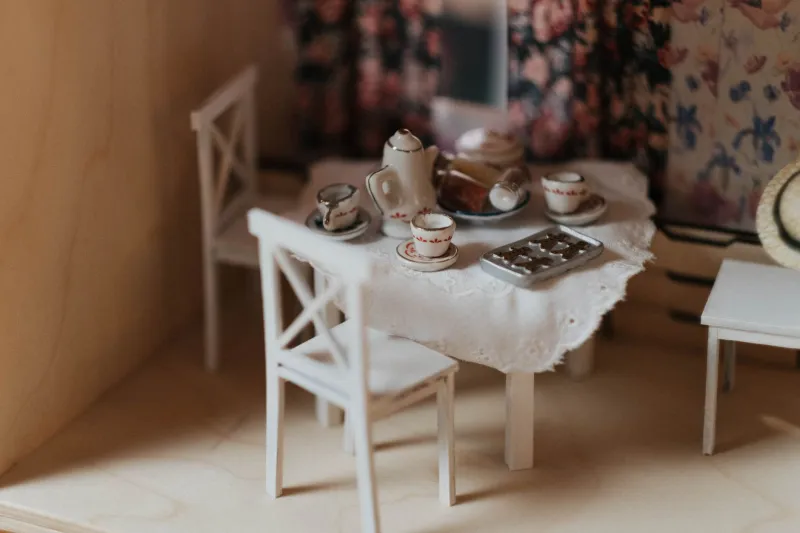
9. Tea archaeology. A mug ring on the worktop, a spoon rest with a stain in the shape of a spoon, a kettle with a limescale tide mark inside the spout, and a tea towel that has been used for everything. Paint the mug ring with a thinned brown wash and a circle cut from a punch. It is the cheapest realism you will ever buy.
The unglamorous services
10. The meter cupboard. Gas meter, electricity key meter, a consumer unit with a strip of sticky labels in biro, and a boiler hanging on a kitchen wall with a condensate pipe running out through the brickwork. Model the whole lot as one boxed-in corner and let a clutter of coats and a Henry hoover live in front of it.
11. Floors that show a route. A stair runner held by brass rods, a carpet with a worn path from the door to the window, a bit of lino curling at the edge. At 1:12 you can fake the wear by sanding a strip of flocked paper and dry-brushing a lighter tone over the top.
12. The back door step. A wheelie bin with the house number painted on, a recycling box, a pair of knackered trainers, a hanging basket bracket with nothing in it. It is outside the room and inside the story.
The photograph test
When you think a room is finished, get the camera down to eye level and shoot it against a window. Anything that reads wrong will jump out — usually a socket, a skirting or a curtain. Fix those three and the room stops being a model of a house and starts being somebody's house, which is the only thing worth chasing.