Copper Cylinder, Folded Sheets: The 1:12 Cupboard That Makes a House Feel Lived In
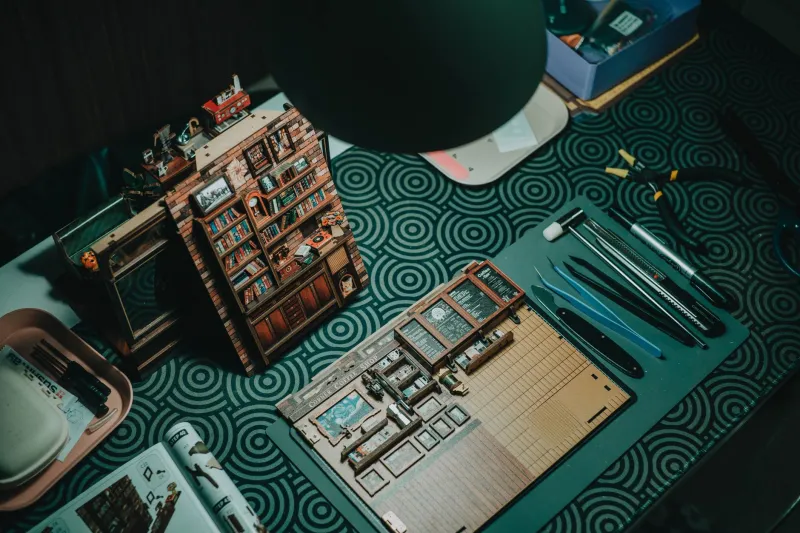
Every 1:12 house has a front door, a kitchen and a sofa. Fewer have a cupboard that smells faintly of warm cotton and old talcum powder. That is the airing cupboard’s quiet power: it is not a room you show off, it is a room that explains the rest of the house. Open it and you find the boiler’s copper cylinder, the lagged pipes, the spare towels and the sheet set that never quite matches. It is domestic life with the door shut, and at one twelfth scale it rewards anyone curious enough to look.
Start With the Box Behind the Door
An airing cupboard is usually a shallow cupboard built around a hot-water cylinder, often in the bathroom or on the landing. At 1:12, a realistic footprint is roughly 50mm deep, 75mm wide and 160mm tall — though a wider landing cupboard at 75mm by 100mm gives you more shelf to play with. Build the carcass from 3mm basswood or obeche, with 2mm stripwood for the face frame. If the cupboard sits in a wall, leave the back open or paint it a dull off-white so the interior reads as part of the building rather than a standalone box.
The door matters more than the box. Hinge it properly with tiny brass hinges or a strip of fine leather, and add a small catch so it stays closed but opens with a fingertip. A cupboard that cannot be opened is just a panel. A cupboard that swings open is an invitation.
Slats, Cylinder and a Sensible Amount of Pipework
The airing cupboard’s signature is the slatted shelf. Real slats are often around 50mm wide with 20mm gaps; at 1:12 that becomes 4mm wide stripwood with roughly 1.5mm to 2mm gaps. Use 1.5mm by 4mm stripwood, cut slightly oversize, and space the slats with a scrap of 2mm card as a jig. Paint them a warm, slightly yellowed white — not brilliant white. The gaps let warm air through, and they also cast wonderful little shadows.
The cylinder is the centrepiece. A standard copper hot-water cylinder is about 450mm across, which is 37.5mm at 1:12. A 35mm dowel is close enough for most viewers, especially if it sits toward the back. Cut it to about 70mm tall, round the top with sandpaper, and paint it copper with a touch of dark brown in the shadows. Add a white plastic immersion heater cap on top: a short 8mm cylinder of styrene or painted dowel, with a tiny thermostat box beside it. Pipes can be 2mm and 3mm brass tube or styrene rod, bent gently and run down the back corner. Lagging is easy: wrap masking tape or thin craft foam around the pipe, tie it with dark thread at intervals, and paint the whole lot a faded cream. It should look slightly lumpy and slightly neglected, because real lagging does.
Linen That Looks Folded by a Human
Folded linen is where many miniature cupboards go wrong. Tiny perfect rectangles look like paper. Real sheets are softer, slightly askew and never quite the same size. Cut cotton fabric from an old handkerchief or shirt, fray the edges very slightly, and stiffen it with a weak PVA-and-water mix. Fold while damp, press with a fingernail, and let it dry. A stack of two or three folded sheets is plenty. Add a towel with a woven stripe — a fine line of acrylic paint along the edge — and a face cloth that has been dropped rather than placed.
Use colour like a British linen cupboard: cream, pale blue, faded pink, a little oatmeal. Avoid bright primary colours unless the house is deliberately mid-century. A tiny lavender bag made from a square of fabric and a dot of purple paint adds a scent you cannot smell but your eye believes in.
Clutter With a Job to Do
Do not fill every shelf. The airing cupboard should feel used but not chaotic. Give each object a reason to be there: a spare loo roll, a hot-water bottle with a knitted cover, a jar of clothes pegs, a folded laundry basket made from fine card strips woven over a 10mm frame. A single coat hanger on a hook, a box of soap powder, a torch for power cuts — all are plausible and all add story. The laundry basket should sit on the floor, slightly pulled out, as if someone has just been interrupted.
Leave at least one shelf half empty. Negative space makes the clutter look chosen rather than dumped, and it gives the viewer’s eye somewhere to rest. A cupboard crammed to the ceiling reads as a model shop shelf; a cupboard with a gap reads as a home.
Lighting, Labels and the Payoff
Most airing cupboards have no light, but a hidden warm-white LED behind the door frame can be a lovely cheat. Keep it dim and yellow — think 2700K, not operating theatre. If you do not want electrics, simply paint the interior a warm cream and let the hallway light do the work.
Add small labels in 1:12: LINEN on a card tag, HOT WATER on the cylinder, a handwritten note taped to the door reading ‘Do not turn off’. These tiny details reward close inspection and cost almost nothing. A pencil mark on the door frame showing heights, or a faded water stain on the shelf, adds history without adding objects.
The real payoff is the open door. When a viewer opens it, they should get a small jolt of recognition: the cylinder, the slats, the folded sheets, the faint sense of a house being maintained. That is the airing cupboard’s job. It is not the warmest door in the house because of the heating; it is the warmest because it is the one that admits ordinary life goes on behind it.